The beautiful nature of our country has begun to wrap itself in a green robe. This year, however, the rains came steadily, and the soil has clearly drunk in plenty of moisture. By February, the first spring flowers in Turkmenistan had already spilled their beauty across the fields. Every year, therefore, we begin our scientific observations early within the Köpetdag State Nature Reserve. In this way, we follow the growth cycle of these delicate, charming blooms.
In the last ten days of February, the däligöje brightened the meadows with its white blossoms. We recorded its flowering at 2,000 metres above sea level. We also saw it at Çaýek, Gökdere, Bakja, Mürzedag and Guryhowdan.
The snake onion among Turkmenistan’s spring flowers
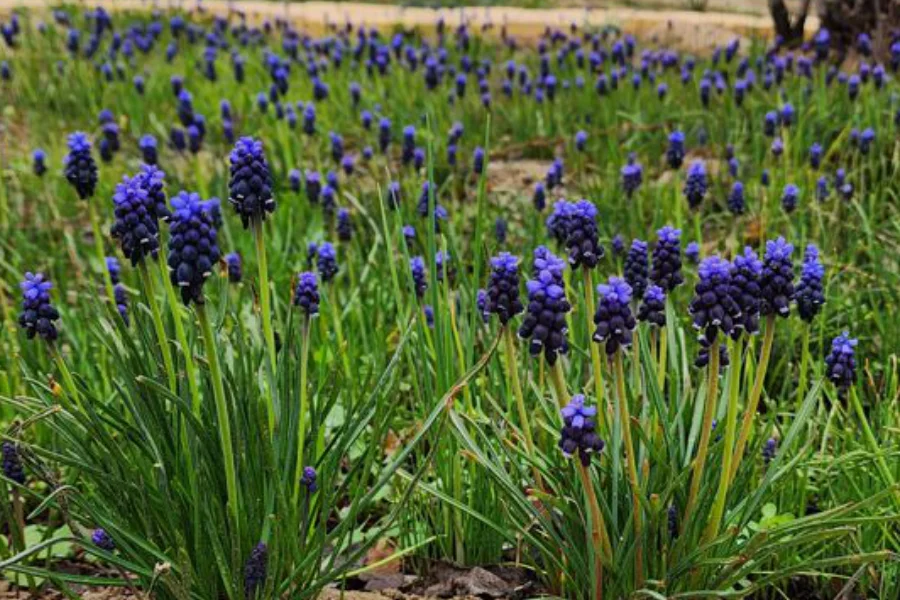
Right now, though, one plant catches the eye above the rest. It lends the mountains a beauty all its own — the snake onion, with its tiny, ink-dark flowers. Indeed, the snake onion (Muscari leucostomum) ranks among the earliest heralds of the Turkmen spring.
It belongs to the lily family (Liliaceae). This perennial herb grows just 10–30 centimetres tall. Its round bulb hides in the soil and measures only 1–2 centimetres across. The flower shows a deep, saturated ink colour, while the fruit forms a capsule that splits open when ripe. So the plant blooms in March and April.
Out in the fields, the snake onion’s ink-blue flowers stand among the yellow goose onion (Gagea) and the sarysolmaz. As a result, your eye goes straight to the little meadow-garden that nature has arranged.
Where the snake onion grows
The snake onion spreads through the mountains. It climbs the high, middle and low mountain belts alike. In our country, moreover, it grows at Kürendag, the South-Western and Central Köpetdag, the Eastern Köpetdag, Bathyz and Köýtendag.
People use the bulb as raw material for medicine. Above all, it helps in treating skin conditions. The scientific encyclopaedia Medicinal Plants of Turkmenistan sets out its value. Indeed, the National Leader of the Turkmen people, Hero Arkadag, compiled this work.
Tracking the bloom inside the reserve
This year we first logged the snake onion’s growing season on 14 January at the Kiçi Bakja site. Soon after, in early February, we noted the first flowering plants at Mürzedag and Kiçi Bakja. Then, in the second ten days of the month, mass flowering reached its peak at Kiçi Bakja.
A. Potaýewa, head of the Scientific Department, told us about the early trials. Back in 2013, staff began propagating the snake onion and various tulips at the experimental plot in Bekrewe. Year after year, the plant has spread from seed and multiplied from its bulbs as well. On the plot, it reached full flower at the end of February. Even now, fresh blooms keep opening.
The snake onion counts among the rare wild herbs of our land. Local flower-growers, too, love these field blooms. Above all, they reach for the heralds of spring when they gather bouquets. As reserve staff, however, we explain that no one may pick tulips or other flowers from the wild. We also walk people through the laws that guard every plant’s gene pool. These include the Law on Nature Protection (2014) and the Law on the Plant World (2012).
Now, as March arrives, plant after plant across our landscapes has begun its growing season. So we press on with our work. On the reserve and nearby fields, we keep observing the tulips and other plants come into their own.
Recommended
Source: mineco gov tm