
It is hard to imagine another group of creatures as captivating, astonishing, and uplifting as birds. Around 9,000 bird species live across the world, and scientists divide them into 28 orders. The fauna of Turkmenistan covers 18 of these orders and includes 446 species.
Since ancient times, birds have drawn human attention with their boundless beauty. Birds of prey — medium and large raptors with powerful beaks and sharp talons — form a group of nearly 290 species. In Turkmenistan, you can find 36 of them across 3 families. One of these raptors is the white-tailed eagle.
What the white-tailed eagle looks like
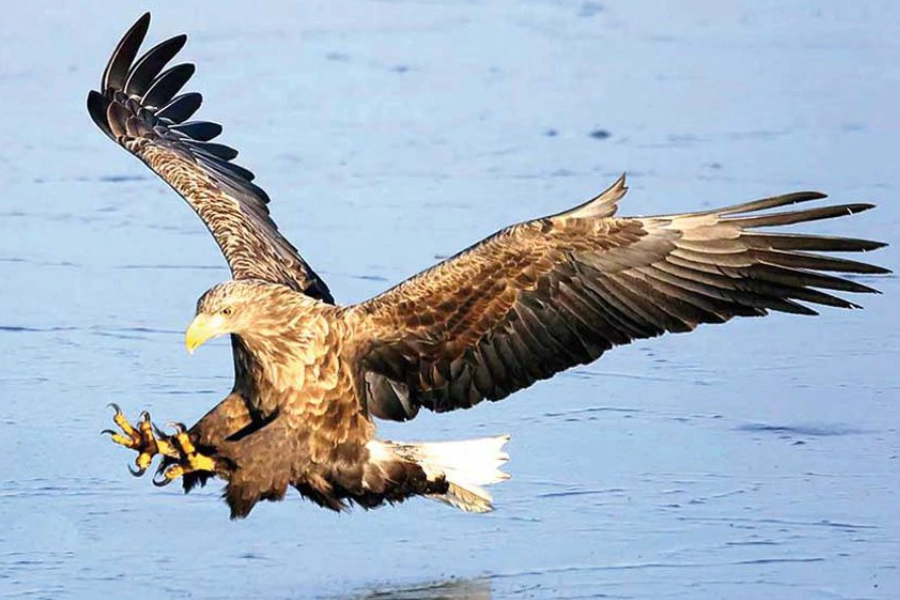
Around the world, the eagle stands as a symbol of fearlessness and valor. The white-tailed eagle (Haliaeetus albicilla) is a large member of its genus, and it is noticeably bigger than the golden eagle. Its body is sturdy, and its broad, long wings reach a span of 2–2.5 meters. Moreover, its eyesight is remarkably sharp — five to six times keener than a human’s.
The beak and legs are robust, the body is well-proportioned, and the build is heavy. In color, the bird is dark brown, while the feathers on its head, neck, and underside are light brown. Compared with other eagles, its tail is short and wedge-shaped. Adult birds carry a white tail, whereas young birds have a brown one.
The female differs from the male only in size. Young birds show an entirely dark-brown back and a light-brown underside. In adults the beak is yellow, but in young birds it stays darker, and the feet remain featherless. Unlike other eagles, the white-tailed eagle flies heavily and rarely soars. Overall, it reaches 60–100 cm in length and weighs up to 3–6.5 kg.
Habitat and migration
The white-tailed eagle mainly inhabits Northern Asia. However, in the autumn and winter months it also appears in the Turkmen part of the Caspian Sea. During the cold season, part of the population migrates and moves slightly south — as far as the foothills of the Himalayas.
Nesting and breeding
Depending on the nesting site, the eagle lays its eggs across a long stretch of spring. It weaves a dense nest from thick branches and lines the inside with dry wood and bark. Often, a pair returns to the same nest for many years. As a rule, these birds settle in tall trees and along sea coasts.
At the end of February, the female incubates 2–3 eggs for 37–40 days. While the chicks are weak and cannot feed themselves, the male hunts and brings food to the nest. Later, once the chicks grow and begin to peck on their own, the female also joins the hunt.
What the white-tailed eagle eats
The eagle’s main food is fish, along with sick or weakened waterbirds — such as coots, ducks, and occasionally swans or ruddy shelducks — and their carrion. Some pairs therefore settle near fish-rich reservoirs. According to scientific data, the white-tailed eagle also attacks weakened or frozen birds on the Caspian Sea.
A symbol of loyalty
In ancient Egypt and China, people regarded the eagle as a symbol of the Sun. Eagles are also remarkably faithful birds, and they never betray one another. For example, European ornithologists point to eagle pairs that have stayed together for 35 years.
Conservation status
The white-tailed eagle is a rare species with a stable population, and it appears in our country mainly during winter. For this reason, catching and hunting the bird is strictly prohibited.
Winter census on the Caspian Sea
As is well known, every January the specialists of the Scientific and Protection Department of the Caspian State Nature Reserve carry out a winter count of the waterbirds wintering in the Turkmen part of the Caspian Sea. During this year’s count, they recorded 120 white-tailed eagles along the shores of the Turkmen sector of the Caspian Sea.
Recommended

Source: mineco gov tm