Winter Bird Surveys in Turkmenistan’s Nature Reserves
Among the wildlife of Turkmenistan, the world of birds stands out for its remarkable diversity. According to ornithologists, close to 445 bird species occur across the country. These birds astonish observers with their beauty and their distinctive ways of life. To protect them, reserve staff carry out regular bird surveys in Turkmenistan throughout the year at the state nature reserves managed by the Ministry of Environmental Protection.
At present, winter monitoring is underway across these reserves. During the cold season, specialists study the species composition of birds that continue their migration or stay to overwinter, and they plan measures to safeguard them. Studying and conserving these creatures scientifically holds great importance for the country’s many ecosystems.
Winter monitoring at the Mäne-Çäçe site
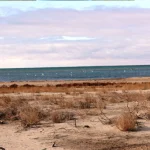
The latest field work took place at the Mäne-Çäçe protected site of the Köpetdag State Nature Reserve and the areas around it. Researchers surveyed drainage channels, shallow pools left by rainfall, irrigated farmland and wetland areas. In addition, a film crew from Turkmenistan’s “Altyn-Asyr” television channel joined the work to prepare a programme about birds.
The reserve’s state inspectors — Ö. Nepesow, G. Baýramow, A. Jumalyýew and O. Meredow — carried out the count. Alongside the survey, they also held outreach talks with local residents, explaining Turkmenistan’s environmental laws and regulations.
Cranes gather near Durnaly Shor
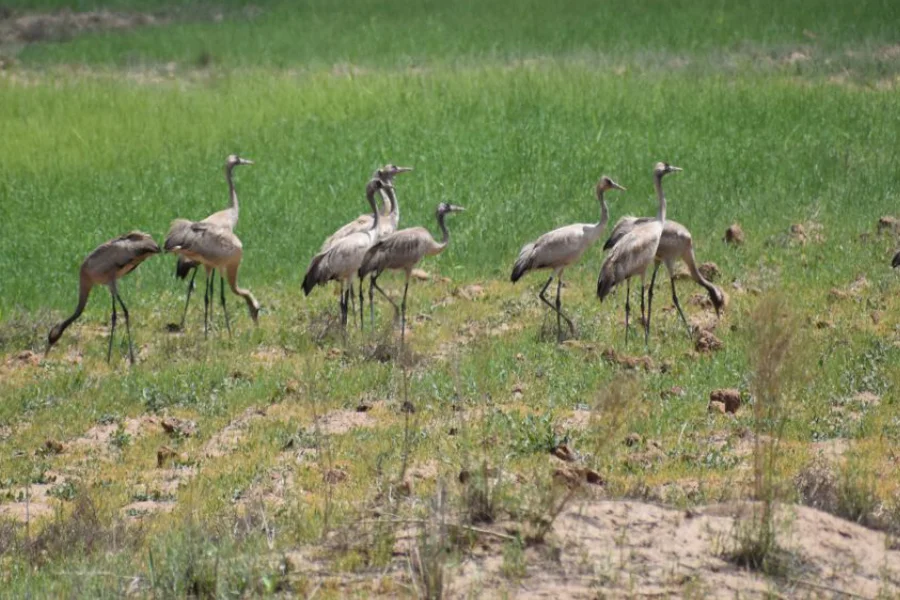
At the Mäne-Çäçe site, visitors can now see a large flock of common cranes (Grus grus) at close range. The species ranges from southern Europe and Asia Minor to Kazakhstan and western Siberia. Moreover, it winters in southern Europe, the Gulf states, southern Uzbekistan, Turkmenistan, Afghanistan, Pakistan, India and North Africa.
Crane counts take place each year in early spring and autumn, while the wintering population is studied during the cold months. Every year, thousands of cranes gather near “Durnaly Shor”, which lies within the Hakykat farmers’ association in the Altyn Asyr district of Ahal province. For many years this place has been a known site and a key home for cranes.
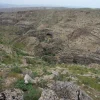
The surrounding land is covered with saxaul and tamarisk, and wolves, jackals, foxes and wild boar appear here. This winter, more than 300 cranes stayed to overwinter. During the day they feed among young crops and tamarisk. Before dawn, while it is still dark, the cranes fly up from the salt flat and spread across the fields in flock after flock. Shepherds tending their sheep and goats reported that they see these beautiful birds up close every day, because the cranes sense no danger nearby.
Sandgrouse and little bustards on the plain
Large flocks of black-bellied sandgrouse (Pterocles orientalis) also gather on the Mäne-Çäçe plain each year. This species occurs across all the lowland areas of Turkmenistan. It winters in the south-west of the country, and its migration runs along the foothills of the Köpetdag. Along the road from Çäçe village to Durnaly Shor, the team counted more than 2,000 birds within sight of the vehicle. In the first half of the day the sandgrouse stayed on tamarisk-covered ground, then moved out into open country.
The little bustard (Tetrax tetrax) is a passage, breeding and wintering bird here. It appears in large numbers every year, recorded over oases, along the Köpetdag foothills and in river valleys. Recently it also turned up in the fields of Ak Bugdaý district. On the tamarisk ground of the Mäne-Çäçe plain, the survey recorded more than 400 little bustards, while tenant farmers reported seeing many on their croplands as well.
Other species recorded during the bird surveys in Turkmenistan
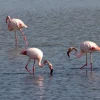
Among the ducks, the team noted mallard (Anas platyrhynchos) and Eurasian teal (Anas crecca) in the shallow waters. The survey areas also produced records of common kestrel (Falco tinnunculus), Eurasian eagle-owl (Bubo bubo), hen harrier (Circus cyaneus), great egret (Casmerodius albus), common starling (Sturnus vulgaris), crested lark (Galerida cristata), bimaculated lark (Melanocorypha bimaculata), great grey shrike (Lanius excubitor), desert finch (Rhodospiza obsoleta), Eurasian magpie (Pica pica) and rock dove (Columba livia). As a result, the work gathered valuable data on the species composition and occurrence of birds at the site.
Protecting wetlands and the Ramsar commitment
The surveys also underlined how important it is to conserve the places where birds live. Under changing climate conditions, monitoring the yearly state of the wetlands near the Mäne-Çäçe plain is essential, because these wet and marshy areas matter greatly for several bird species and for other wildlife. In this regard, Turkmenistan made a notable international contribution by joining the Ramsar Convention on 22 February 2008, strengthening the protection of wetlands of international importance.
Recommended

Source: mineco gov tm