This year’s mild winter and steady rainfall coaxed the early flowering plants of Turkmenistan awake ahead of schedule in Koytendag. Botanists recorded a striking shift in the reserve’s phenological rhythm. Familiar bloom patterns changed, and spring plant life began well ahead of the long-term average. The whole natural calendar shifted. The first to answer spring’s early call were Koytendag’s beloved ephemeroids — the fleeting, fast-living flowers that define the region’s earliest weeks of the year.
A Race Against the Thaw: Early Flowering Plants Turkmenistan Style
Snow still capped the peaks of the Koytendag ridge, and cold air still pooled in the valleys. Yet something remarkable was already underway on the mountain slopes. As soon as the spring sun warmed the ground, slopes that looked lifeless burst into living color. This is the ephemeroid strategy at work. These plants have an extraordinarily short, urgent life cycle, and they rush to flower while the soil is still moist. These species “outsmart” Koytendag’s harsh mountain climate by exploiting the brief early-spring window between winter’s bitter cold and summer’s drought. The moment air temperature rises above 0°C, they draw on food reserves stored in their bulbs and roots. Then they launch into rapid growth. Everything happens fast. Within a few weeks, an ephemeroid must grow, flower, and scatter ripe seed. That’s exactly why people call these plants “early bloomers,” or, more poetically, the messengers of spring.
Long-term phenological monitoring shows spring arrived roughly 15 days earlier than average this year (see the Ramsar Convention’s wetland and habitat monitoring guidance for comparable methodology). This shift in natural rhythm meant the region’s distinctive plants flowered ahead of time. By the first half of March, the mountain slopes were already awash in color. Nature rarely moves with this kind of urgency. Normally these species take turns, each replacing the last in a slow relay. This season’s mild winter brought several into bloom at once, creating a rare, overlapping burst of color.
The Golden Vanguard: Dwarf Gagea
The dwarf gagea (Gagea sp.) was the first to respond to this year’s favorable conditions. It’s a small member of the lily family. Its tiny, bright-yellow, star-shaped flowers began appearing on the first patches of ground to warm in the sun. With its startling growth speed, this “flower beneath the snow” became the true herald of the 2026 spring season. It breaks through the soil as soon as sunlight begins heating it. This year its golden petals appeared thicker and earlier than usual at the foot of Koytendag.
Right behind it, on sun-facing valley slopes, [däligöjele — Turkmen common name, scientific name to confirm] and Kesselring’s colchicum (Colchicum kesselringii) announced their own arrival. What’s remarkable is that these plants begin flowering while most others are still asleep. It’s one of nature’s quieter mysteries here. [Däligöjele] starts growing the moment the snow melts, or as soon as the top layer of soil begins to warm. Its leaves are slender and delicate, and the plant itself looks fragile, yet it easily withstands the chilly March nights.
Korolkow’s Crocus Joins the Race
Next in line is Korolkow’s crocus (Crocus korolkowii), which appears while snow is still only partly melted. Most early flowering plants in Turkmenistan favor pink or white tones, but this crocus announces spring in deep golden yellow. Its yellow blooms — like little cups — are among the first to open on sunny slopes. They often race [däligöjele] in spring’s early marathon. Its gold-yellow flowers sometimes seem to punch straight through the last patches of snow. For conservation status and distribution data on this and related bulb species, see the IUCN Red List.
Sheltered Gorges, Different Rules
Deep gorges cut through Koytendag, and these gorges create their own microclimate. In winter, the air inside stays mild and humid, though light is scarce. It’s in these conditions that Popov’s corydalis (Corydalis popovii) is the first to appear each spring. Its intricate flowers stand out for their unusual form. The plant favors soft, sheltered spots tucked into rock ledges and crevices within the gorges.
Fedchenko’s primrose (Primula fedtschenkoi) is the true ornament of shaded cliffs and damp ground. Its delicate pink-violet flowers look remarkably refined against the imposing mountain landscape. The primrose is also a reliable indicator of moisture — you won’t find it in dry, sun-baked spots. It prefers “weeping” rock faces and the places where mountain streams run. If the primrose blooms unusually abundantly in a given year, take note. That typically signals a snowy winter followed by a mild spring.
The primrose has long held a place in traditional Turkmen medicine. Its poetic name — tied to Nowruz — comes from the fact that it blooms right around the spring equinox. In Koytendag, locals also call it “Birseper,” a name that points to its medicinal use. It has long served as a folk remedy for wounds and digestive ailments.
Rare Irises Among Koytendag’s Early Flowering Plants
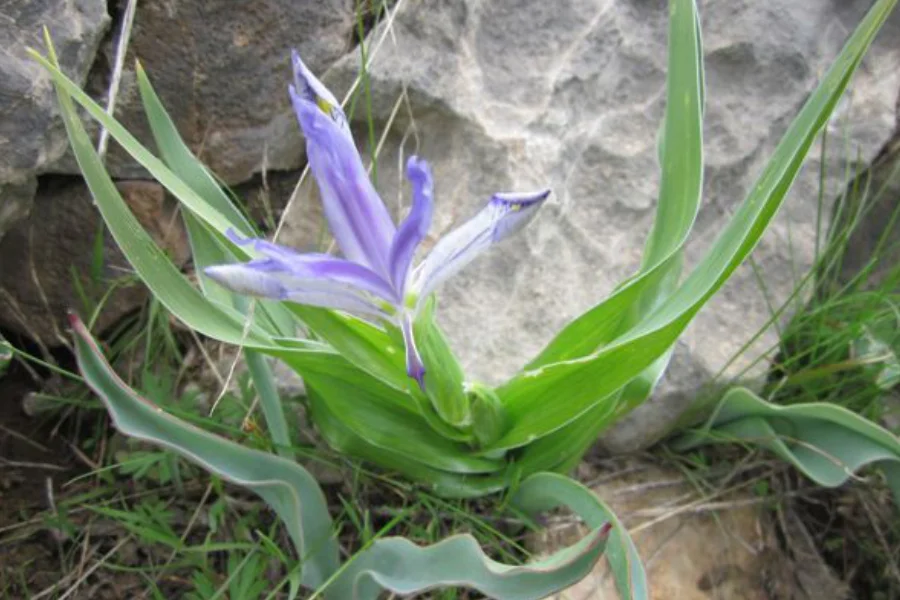
By early March, two rare Juno iris species decorated slopes and foothills across Koytendag. These plants grow nowhere else in Turkmenistan. The first, the Bukhara iris (Iris bucharica), is a true mountain aristocrat. Its striking flowers are elaborate in form and iris-like in color. That makes it one of Koytendag’s most beautiful and rare plants. Unlike most early bloomers, it has unusually long, fleshy roots that reach deep into rock crevices. This adaptation makes it not just beautiful but remarkably tough against the region’s harsh mountain climate. Full taxonomic and distribution details for this species are available via Plants of the World Online (Kew).
The second species claiming its place on sunlit slopes is the Koytendag Juno (Iris kuschakewiczii). Growing to about 30 cm, this striking bulbous plant draws the eye with large, rich violet or deep crimson blooms. Bright yellow markings on the lower petals add a distinctive touch and draw in pollinating insects. Spotting a Juno in flower counts as a stroke of luck for any naturalist. Alongside these irises, the mountain’s golden rock alyssum is also in bloom. Unlike lowland alyssum, Koytendag’s mountain form is a true “athlete.” It clings tightly to rock faces for shelter from the wind. Its golden clusters act almost like a living clock for anyone watching closely. This year its golden carpet covered the foothills earlier than usual, giving early-waking insects their first celebration of the season.
Why These Early Flowering Plants Matter for Turkmenistan’s Ecosystem
Koytendag’s early flowering plants play an outsized role in keeping the reserve’s ecosystem in balance. Blooming right after snowmelt, they help hold soil in place and prevent erosion. They also provide an essential early source of nectar for pollinators. Wild bees and butterflies emerging from winter dormancy depend on it. UNEP outlines related pollinator-conservation frameworks.
These plants do more than delight the eye — many also carry unique medicinal and ornamental value. That’s why the fourth edition of Turkmenistan’s Red Data Book, published in 2024, added several of the most valuable endemic and rare species here. These include Korolkow’s crocus, Popov’s corydalis, and Fedchenko’s primrose. Koytendag’s nature is genuinely unique, and its plant life is a treasure for the whole country. It’s home to a striking number of species found nowhere else on Earth. Read more about the reserve’s broader biodiversity on our nature reserves overview page.
A Gentle Reminder for Visitors
Koytendag’s beauty belongs to everyone who lives here or comes to visit. Because ephemeroids have such a short growing season, any damage to their above-ground parts can rob the bulb of its chance to store energy for next year. Picking the flowers can ultimately wipe the plant out entirely. The best way to hold on to this beauty is with a photograph. Modern digital technology lets us capture every vein on a paper-thin petal. We don’t need to lay a hand on a fragile mountain ecosystem to do it. Koytendag’s spring is a brief window of beauty. Come admire it, photograph it, and leave nothing behind but footprints on the trail. Protecting these singular plants matters. It’s how the reserve’s natural calendar keeps bringing us, and future generations, this same sense of wonder.
Recommended
Source: mineco gov tm