Turkmenistan’s Natural Monuments: A Geology Museum Journey
Turkmenistan has built out its education system to meet international standards. One clear sign: schools and universities now work closely together. These partnerships give students continuity between the classroom and higher education. Field trips to university museums are one of the most memorable results. There, the country’s natural monuments come to life long before students ever set foot on the actual mountains, deserts, or coastlines.
A Living Classroom for Central Asia’s Students
Coordination between universities and schools runs through several channels. These include joint methodology work, professional development courses where university staff retrain teachers, and career-guidance activities like open days, talks, lectures, and campus tours. Science outreach for children and teenagers sits at the center of this effort. The goal: make knowledge approachable, not abstract.
Class teachers regularly organize excursions to Magtymguly Turkmen State University. These trips draw pupils from schools across the country, including the Turkmen-Russian school named after A.S. Pushkin. Their destination is the university’s Geology Museum, part of the Geography Faculty. There, staff run educational sessions for both university students and visiting schoolchildren. Faculty lecturers open each visit with talks on the university’s history and its programs for training specialists, bachelors, and graduate students. Students often enjoy this part most: stories about the historical figures the university and its buildings honor, and how the university partners with international research centers.
Karst Caves and the “Flowers of Stone”
Inside the museum, students learn about the country’s underground resources, its geological and historical record, and the deep-earth processes that shape the land above and below the surface. A dedicated section covers the natural monuments of Koytendag: its dramatic canyons, waterfalls, and botanical and landscape sites.
Dioramas here recreate the karst caves of the Koytendag mountains. They show visitors the mineral formations that build up inside: stalactites, stalagmites, and delicate branching growths known as “flowers of stone.” Many students will never visit the caves themselves. For them, these models offer a first real sense of how the formations take shape underground.
The Dinosaur Plateau
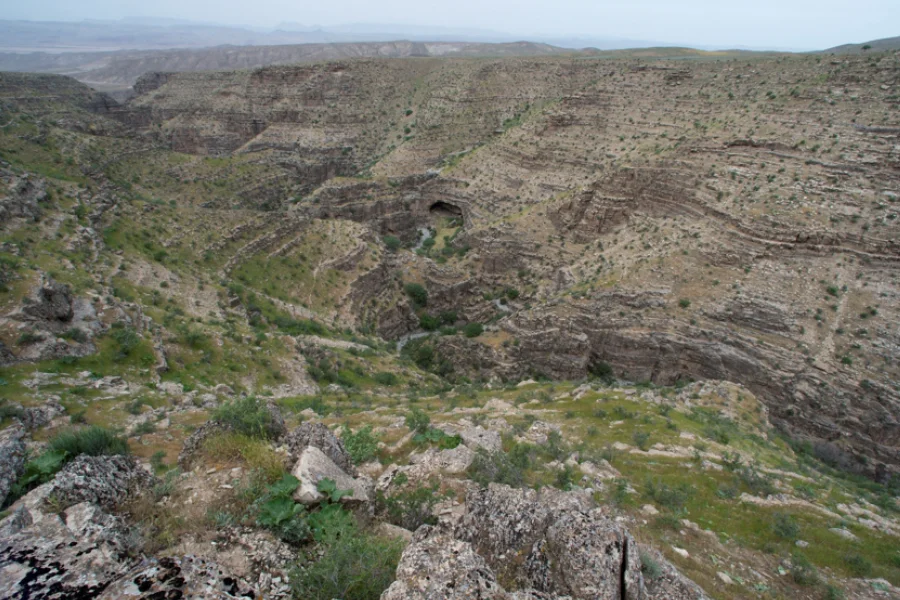
One exhibit draws more attention than any other. It’s a scale model of the site locals call the Plateau of Dinosaurs — a tilted limestone slab in the Koytendag mountains. The slab preserves several hundred fossilised dinosaur footprints from the Jurassic period. The museum’s “Jurassic Park”-style model reconstructs the full range of dinosaur species found at the site.
(A quick editorial flag: published figures for the number of footprints at the Koytendag site vary considerably between sources — some cite a few hundred, others put the count well into the thousands. The source material for this piece states approximately 650; you may want to confirm which figure your organization prefers to publish before this goes live.)
Fire and Mud: The Volcanoes of Western Turkmenistan
Western Turkmenistan’s defining natural monuments are its mud volcanoes. These active vents periodically push mixtures of mud, gas, water, and oil to the surface. Some, including Akpatlawuk and Gokpatlawuk, closely resemble true magmatic volcanoes. Geologists count them among the world’s landscape-geological monuments.
Among the largest is Boyadag — literally “mountain of colors.” Its banded red, brown, and ochre slopes make it one of the most visually striking sites on the Caspian coast. The Geology Museum built a large-scale relief model of Boyadag from detailed topographic surveys and imagery. It gives visitors a sense of the volcano’s true structure without the trip to Balkan Province.
Garabogazkol: Nature’s Chemical Laboratory
The museum’s final natural-monument display covers Garabogazkol, the shallow, salt-saturated lagoon on Turkmenistan’s Caspian coast. Internationally, it’s known as Kara-Bogaz-Gol. Desert surrounds the bay on nearly every side. It ranks among the world’s richest natural sources of hydromineral raw material — principally sodium sulfate — and feeds the country’s chemical industry. Its water balance ties closely to the wider Caspian Sea coastline. That link places it within the broader environmental cooperation framework of the Tehran Convention.
Why These Field Trips Matter
For visiting students, a trip to the Geology Museum is more than a break from the classroom. It’s a structured introduction to the earth sciences — geology, paleontology, and the study of Turkmenistan’s mineral wealth — and to how these fields connect. The excursions do more than build curiosity. Students handle geological specimens directly. They come away with a fuller picture of the country’s underground resources, its rock formations, and its natural monuments: the karst caves and dinosaur tracks of Koytendag Nature Reserve, the mud volcanoes of western Turkmenistan, and the salt flats of Garabogazkol.
Recommended
Source: mineco gov tm