Greater Flamingos Return to Garakol Lake in Turkmenistan
The Caspian Sea, together with Turkmenistan’s rivers and lakes, forms a vital living space for the country’s wildlife. In particular, birds benefit from this habitat most of all. Garakol, a small lake within the Magtymguly farm association in the Shabat district of Dashoguz province, is one such place. Village elders recall a time when many smaller lakes dotted this land. Today, only Garakol and one neighboring pond remain, yet they still draw a striking variety of birds throughout the year.
A Wetland Refuge in the Shabat District
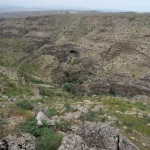
Duck numbers at Garakol rise noticeably in winter. Desert vegetation lines one side of the lake, while farmland borders the other. Local residents who work these fields pass the water’s edge daily, taking in its changing moods. Often, conversations with people resting near the lake turn to its importance and the need to protect it. Regular visits to Dashoguz province now include time spent observing the birds and wildlife around Garakol. As a result, these visits have become part of monitoring the site’s natural value.
A Learning Ground for Local Students
A recent excursion brought together Ogulgözel Amanmyradova, a biology teacher at the village’s School No. 50, and a group of her students. Together, they spent the visit observing the different bird species gathered at the lake. Firsthand encounters like this one help build students’ understanding of nature. They also strengthen a sense of responsibility for the natural beauty of their home village. In turn, this experience lays a foundation for the next generation of local conservation stewardship.
Monitoring With Gaplangyr Nature Reserve
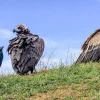
Researchers from Gaplangyr State Nature Reserve have also carried out several rounds of monitoring at Garakol. During surveys in March and June 2026, the following species were recorded:
- Whooper swan, Cygnus cygnus
- Common shelduck, Tadorna tadorna
- Eurasian teal, Anas crecca
- Red-crested pochard, Netta rufina
- Eurasian oystercatcher, Haematopus ostralegus
- Slender-billed gull, Larus genei
- Little gull, Larus minutus
- Purple heron, Ardea purpurea
- Great egret, Ardea alba (recorded locally as Casmerodius albus)
- White-tailed lapwing, Vanellus leucurus
- Black-winged stilt, Himantopus himantopus
- Plover species, Charadrius sp.
- European roller, Coracias garrulus
- Blue-cheeked bee-eater, Merops persicus
- Eurasian tree sparrow, Passer montanus
- Barn swallow, Hirundo rustica
These sightings also included various other ducks and gulls. Flocks of swans were spotted at a distance, on the far side of the lake.
Bird Numbers Surge in July
A follow-up visit in late afternoon in July found the lake transformed. Both the number and variety of birds had grown noticeably, and flocks gathered thickly along the shoreline. This visit also added three more species to the record: little tern, Sternula albifrons (locally recorded as Sterna albifrona), great cormorant, Phalacrocorax carbo, and collared pratincole, Glareola pratincola. Many of the birds present were accompanied by young chicks. In fact, shepherds who graze their flocks near the lake said they watch these birds up close nearly every day.
An Unexpected Encounter: Greater Flamingos at Garakol
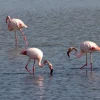
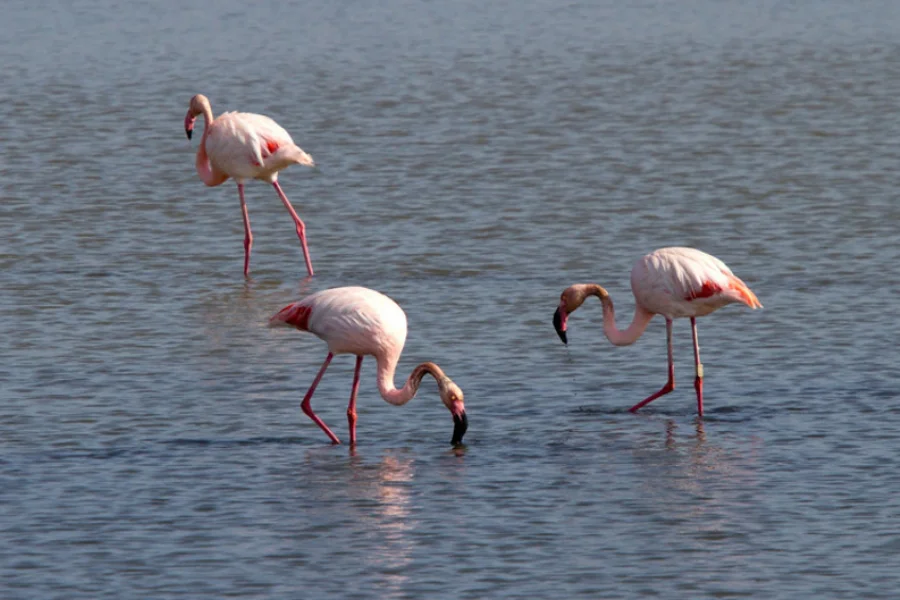
Seyitmuhammet Garajayev, a shepherd who has worked the surrounding land for several years, mentioned something in passing: flamingos were present at the lake. A closer look at photographs taken from a distance across the water confirmed it. They were greater flamingos, Phoenicopterus roseus, at Garakol. Indeed, it was a genuinely surprising and welcome find, since the greater flamingo is a species listed in Turkmenistan’s Red Data Book.
Flamingo Conservation Status in Turkmenistan and Beyond
Within Turkmenistan, greater flamingos are recorded along the Caspian coastline and at the Yerajy, Kelif, and Sarygamysh state nature reserves. They also appear at smaller inland water bodies. Globally, the species is assessed as Least Concern on the IUCN Red List. However, it is also protected under several international agreements. These include CITES, the Convention on International Trade in Endangered Species; the CMS Bonn Convention on migratory species; and AEWA, the Agreement on the Conservation of African-Eurasian Migratory Waterbirds. Its listing in Turkmenistan’s Red Data Book, meanwhile, reflects a national interest in protecting the sites where the species feeds, rests, and breeds. This matters even where global numbers remain stable.
A New Refuge for the Species
Garajayev’s account did not stop at a single sighting. He noted that flamingos had also visited the lake the previous year. He also described watching them bathe and preen where a stream feeds into Garakol on warm days. Taken together, these observations suggest the lake has become a recurring stopover, if not a settled refuge, for the species. This underscores the value of continuing to study exactly where and when flamingos use this wetland.
What Local Voices Say
Writing about the greater flamingo for Turkmenistan’s Red Data Book, ornithologist Eldar Rustamov points to several priorities. These include stronger public outreach on the species’ protection, supplementary winter feeding during harsh cold spells, and consistent counts of birds during migration and wintering. All of these measures, in turn, depend on exactly the kind of grassroots observation happening at Garakol.
For the students from School No. 50, the excursion left a lasting impression. They spoke of wanting to help grow more desert vegetation around the lake in the future. They also said the visit had deepened their pride in their village’s natural surroundings. Overall, it is a small but telling sign of how a single wetland can shape the next generation’s relationship with the land around it.
Recommended

Source: mineco gov tm