The Cinereous Vulture: Badhyz’s Great Scavenger
Turkmenistan is home to nearly 40 species of birds of prey. Among them, one stands out for its sheer size: the cinereous vulture (Aegypius monachus), known locally as gajar. In the Badhyz Nature Reserve, this bird plays a quiet but essential role — keeping the landscape clean.
Turkmenistan’s Largest Bird of Prey
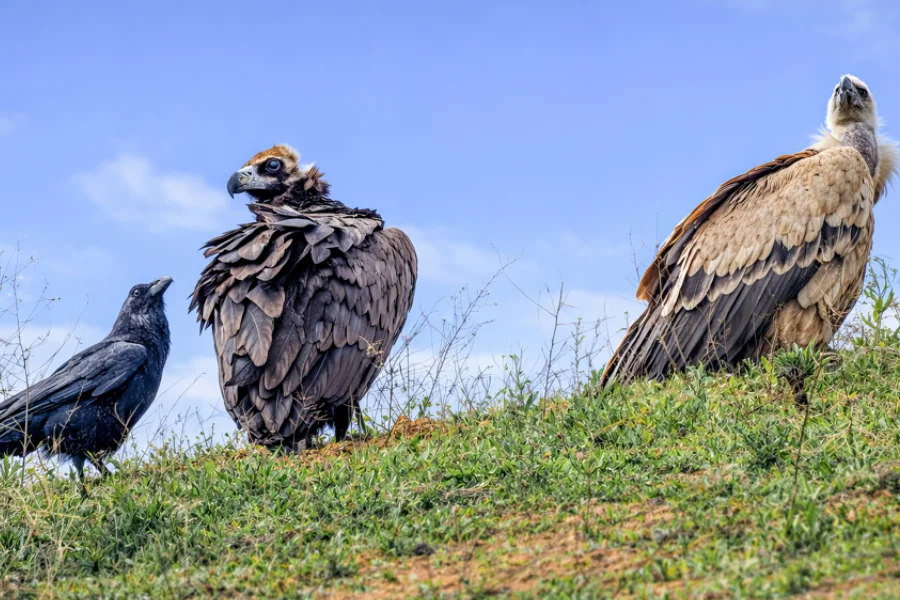
The cinereous vulture is the biggest raptor found in the country. Standing, it reaches over a meter in height. With its wings spread, it approaches 3 meters across, and it weighs between 6 and 7.5 kilograms. Its flight and tail feathers are black, while the rest of its plumage is a deep brown. The downy feathers on its head and the sides of its neck are brown as well, which is why the bird looks almost entirely black from a distance.
One detail matters more than it first appears: the cinereous vulture lacks large feathers on its head and neck. This bare, downy covering is a mark of a highly specialized scavenger — a bird built for reaching deep into carcasses without fouling its plumage.
Nature’s Cleanup Crew
Every bird of prey shapes the ecosystem around it. Some hunt rodents, protecting trees and grasses from pests. Others target the weak, the injured, or the sick among larger animals. A third group — the scavengers — clears the carcasses of animals that died naturally or fell to predators.
In Badhyz, this last group includes the cinereous vulture alongside three other species:
- Bearded vulture (Gypaetus barbatus)
- Egyptian vulture (Neophron percnopterus)
- Griffon vulture (Gyps fulvus)
Together, these birds act as a natural sanitation service across the reserve, which holds one of the densest concentrations of wild ungulates in the region.
Where the Cinereous Vulture Lives in Turkmenistan
Beyond Badhyz, the cinereous vulture also occurs in the Greater Balkan range, the Kopetdag, and the open country between the Amu Darya and Murgap rivers. Its numbers in the wild, however, remain very low. The species is listed on the IUCN Red List and in the Red Book of Turkmenistan.
Nesting Sites in Badhyz
Cinereous vultures in Badhyz are year-round residents rather than migrants. They build their nests in old, healthy pistachio groves, on rocky ledges near Gyzyljar and Yeroyulanduz, and in saxaul thickets growing in sandy hollows.
The birds choose nesting sites with care. They favor spots close to water sources, with a wide view of the surrounding terrain and only gentle airflow. A pair will reuse the same nest for several years, adding to it each season. Over time, though, the growing weight strains the structure, and a strong storm can eventually knock it sideways. When that happens, the pair simply builds again
Unlikely Neighbors: Sparrows in the Vulture’s Nest
A freshly built cinereous vulture nest quickly draws attention from other birds looking for shelter. Sparrows usually win out, settling into the gaps along the lower walls of the structure. It might seem like the vulture would drive off these small intruders, but the opposite happens — the sparrows gain protection from larger predators simply by nesting so close. This kind of peaceful coexistence between raptors and small songbirds turns up often in nature. In Badhyz, as many as 7 to 8 sparrow pairs will nest within a single vulture nest.
Breeding and Raising Chicks
Cinereous vultures lay their eggs in the first half of April, though in some years it happens as early as the second ten days of March. Each pair produces only a single egg — one reason the species recovers so slowly once its numbers decline.
Chicks hatch from mid- to late May, since eggs laid at different times develop on their own schedule. During the peak summer heat of June and July, adult birds spread their wings over the chicks to shade them until the air cools in the evening. Both parents share the work of raising the young.
As the chicks grow, their white down gives way to true feathers. By August, they are fully fledged and already resemble adult birds from a distance — a sign that the new generation will soon take to the air and join the wider population.
How Cinereous Vultures Feed at a Carcass
Cinereous vultures rank among the most efficient scavengers in Badhyz. Once a large predator has killed an ungulate — a goitered gazelle or a urial (Ovis vignei) — and eaten its fill before withdrawing, the vultures are usually the first to reach what remains.
As the sun begins to warm the air, the birds rise 1 to 2 kilometers into the sky and scan the wide landscape below. Once they spot a carcass, they gather from every direction and land near it one by one. Their numbers alone are often enough to push the predator further from its kill.
After that, the vultures move fast. Their powerful beaks tear off large pieces of meat, which they swallow whole, and within five to ten minutes a carcass is reduced to bare bone. At times, the amount of food in a bird’s crop outweighs its own body — leaving it too heavy to take off immediately. To escape danger in that state, the vulture will regurgitate part of what it has eaten before flying to safety.
Winter Movements and Population Stability
During harsh winters, cinereous vultures may travel far from their usual range in search of food. Badhyz and its surrounding areas support large numbers of wild ungulates, along with thousands of livestock grazing on nearby pastures. Natural mortality among these animals provides scavengers with a steady food supply year-round.
This reliable food base is likely why the cinereous vulture population in Badhyz has remained stable, allowing the birds to breed successfully and sustain their numbers in the reserve.
Recommended

Source: mineco gov tm