Eurasian Oystercatcher in Turkmenistan: Wader Survey at Lake Garakol
Turkmenistan’s bird world is remarkably rich. Ornithologists have documented close to 445 species across the country. Every field expedition to a nature reserve adds fresh records — sightings, behavioural notes, distribution data. Over the years, these observations build into a growing archive of species accounts and photographs. This archive now underpins long-term monitoring work.
A Diverse Wader Family Along Turkmenistan’s Wetlands
Turkmenistan’s birdlife includes a group popularly known as çuluklar — plovers, sandpipers, and their close relatives. This group stands out for its variety. Some species are no bigger than a sparrow; others reach the size of a crow. Even within the group, leg and bill length vary widely from one species to the next. So far, Turkmenistan has officially recorded fifteen species, and most of them favour reservoirs, lakes, and the Caspian Sea coast.
Recent fieldwork shows how actively researchers track this group. In April 2025, for example, observers on the Caspian coast got a rare close-up look at two waders (exact English common names pending verification — see note below). The following May, researchers logged a white-tailed wader, likely the White-tailed Lapwing (Vanellus leucurus — verify against source term “Akguýruk çäge çulugy”), at the Amyderya State Nature Reserve. Then in April, a pale-plumaged wader (verify against source term “Çalymtyl çuluk”) turned up along irrigation channels in the Gokdepe district.
Waterbird Survey at Lake Garakol, Shabat District
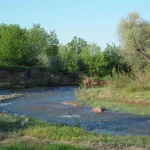
On 21–22 March 2026, researchers surveyed waterbirds at Lake Garakol, within the Magtymguly farmers’ association in the Shabat district of Dashoguz province. The lake takes its name from the nearby village of Garaporsan. According to local elders, the name reflects the area’s abundance of water and lakes, along with its damp, dark-coloured sandy soil.
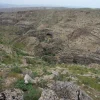
Garakol sits where two very different landscapes meet. Open desert covered in saxaul and other arid-adapted plants lies on one side; cotton and wheat fields border the lake on the other. In winter, this contrast draws an especially wide range of birds to the site.
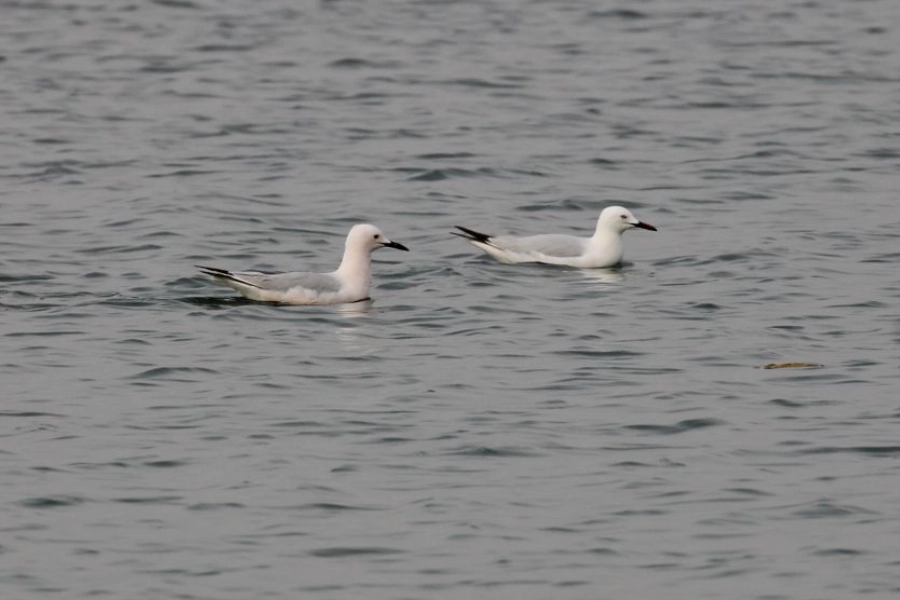
During the March survey, the team recorded several species: Whooper Swan (verify: “sykylykçy guw”), Red-crested Pochard (verify: “almabaş ördek”), Eurasian Wigeon (verify: “sykylykçy jünekeý ördek”), a pigeon-like gull (verify: “kepderi pisintli deňiz çarlagy”), Black-headed Gull, Greater White-fronted Goose (verify: “ala gaz”), and Grey Heron. Further out on the lake, large numbers of additional waterbirds gathered as well.
The saxaul thickets, tamarisk stands, and Euphrates poplars around the lake held their own residents, including Brown-necked Raven and Montagu’s Harrier (verify: “meýdan gulatysy”). Along the shoreline, the team also found fox, jackal, and wildcat tracks.
A Closer Look: The Eurasian Oystercatcher (Haematopus ostralegus)
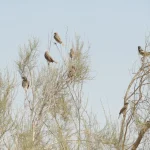
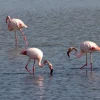
From a distance, the team spotted waders resting on the shore. Once photographed, these birds turned out to belong to a single species: the Eurasian oystercatcher (Haematopus ostralegus), a member of the oystercatcher family, Haematopodidae. This survey’s classification recognises four species within the family, and only the Eurasian oystercatcher occurs in Turkmenistan.
The bird is roughly pigeon-sized. Its head, neck, back, wings, and tail tip are black, while its underparts are white. Its three-toed legs are pink-red, and its long, straight bill is a striking red. In Turkmenistan, this species passes through as a migrant and occasionally nests here too. Birds move through in spring, from March to early May, and again in autumn, from August to November; most nesting happens in mid-May.
Oystercatchers build shallow nest scrapes and line them with small stones, shell fragments, and plant debris. Each clutch holds 3–4 eggs, and chicks fledge in late June and July. For food, this species relies mainly on shellfish, insects, and their larvae. Outside the breeding season, it winters along the coasts of Western Europe, north-west and east Africa, Arabia, India, south-east China, and New Zealand.
Overall, Eurasian oystercatcher numbers stay low, though the species can be locally common while on passage. The IUCN Red List currently classifies it as Near Threatened. Moreover, researchers usually assign Caspian and Central Asian populations to the eastern subspecies Haematopus ostralegus longipes. Still, much remains unknown, and confirming exactly where this bird nests along Turkmenistan’s lakes and Caspian coast stays an open research priority.
Why Lake Garakol Matters for Conservation
Sites like Lake Garakol show why continued survey work on Turkmenistan’s inland waters carries real conservation weight. Protecting the country’s birdlife, and its waterbirds especially, depends on identifying and safeguarding lakes exactly like this one. These small, seasonally rich wetlands punctuate the desert, and they support species moving along the wider Caspian and Central Asian flyways. In turn, findings like these feed directly into the species and habitat data tracked by the IUCN Red List, the Ramsar Convention on Wetlands, and the African-Eurasian Waterbird Agreement (AEWA).
Recommended

Source: mineco gov tm